HubSpot vs Salesforce for Mid-Size B2B Teams: An Honest Comparison
The brochure prices look similar. The real costs are not. Here's what mid-size B2B teams of 25–200 people actually need to know before signing a contract.
Why This Comparison Still Matters in 2026
The HubSpot vs Salesforce debate hasn't gone away - if anything, it's gotten sharper. Salesforce still holds approximately 21.8% of the global CRM market, more than its four nearest competitors combined, and generated over $37 billion in revenue in fiscal year 2025. Meanwhile, HubSpot has grown from $883 million in revenue in 2020 to over $2.6 billion in 2025, now serving more than 228,000 customers in 135+ countries.
Both platforms have also launched significant AI ecosystems in the past year - HubSpot's Breeze AI and Salesforce's Agentforce - making the feature gap more interesting and the cost comparison more nuanced than ever.
But the most important truth is this: the right CRM isn't the one with the biggest logo - it's the one that fits your sales motion, your team size, and your operational reality. This comparison is built for mid-size B2B teams in that 25–200 employee range where the decision is genuinely difficult.
Key stat: Teams using a CRM are 86% more likely to exceed their sales goals, and commonly see 21–30% revenue lifts. But 30–60% of CRM projects still underperform or fail - mostly due to adoption problems, over-complex setups, and under-investment in admin support.
Pricing: The Real Numbers for Mid-Size Teams
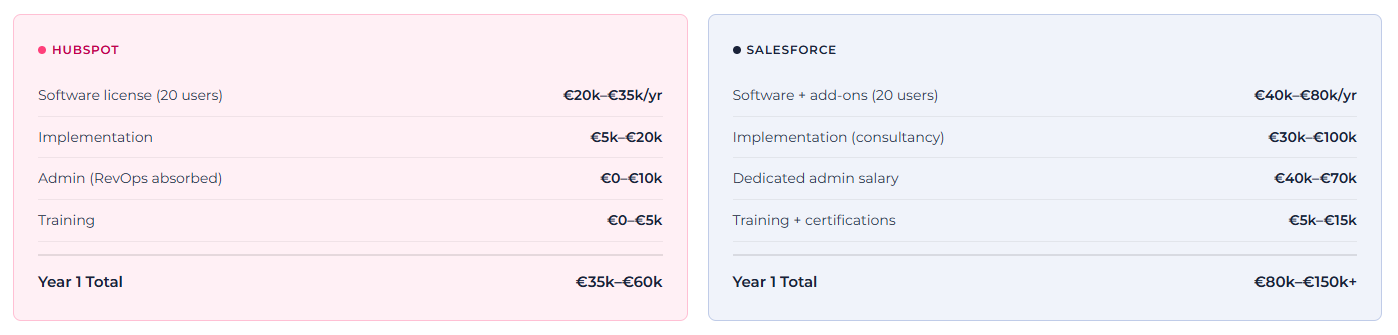
The biggest mistake buyers make is comparing like-for-like on sticker price. Salesforce's entry-level tiers lack API access, workflow automation, and granular reporting - the features a mid-size B2B team actually needs. To reach genuine feature parity, you're comparing HubSpot Professional against Salesforce Enterprise, plus paid add-ons.
The hidden cost trap: Salesforce is an ecosystem of acquired products stitched together - Marketing Cloud (Pardot), CPQ, and Einstein AI are all paid add-ons that can easily double your monthly license fee. HubSpot bundles marketing automation, meeting scheduling, basic quoting, and dashboards natively. The software license is only the tip of the iceberg.
Over a three-year period, Salesforce typically costs 2 x – 3 x more than HubSpot for mid-size teams - not because of license fees alone, but because of the hidden operational costs: the dedicated admin, the consultant-heavy implementation, and the annual uplift baked into renewals (Salesforce applied a 6% list price increase in 2025 alone).
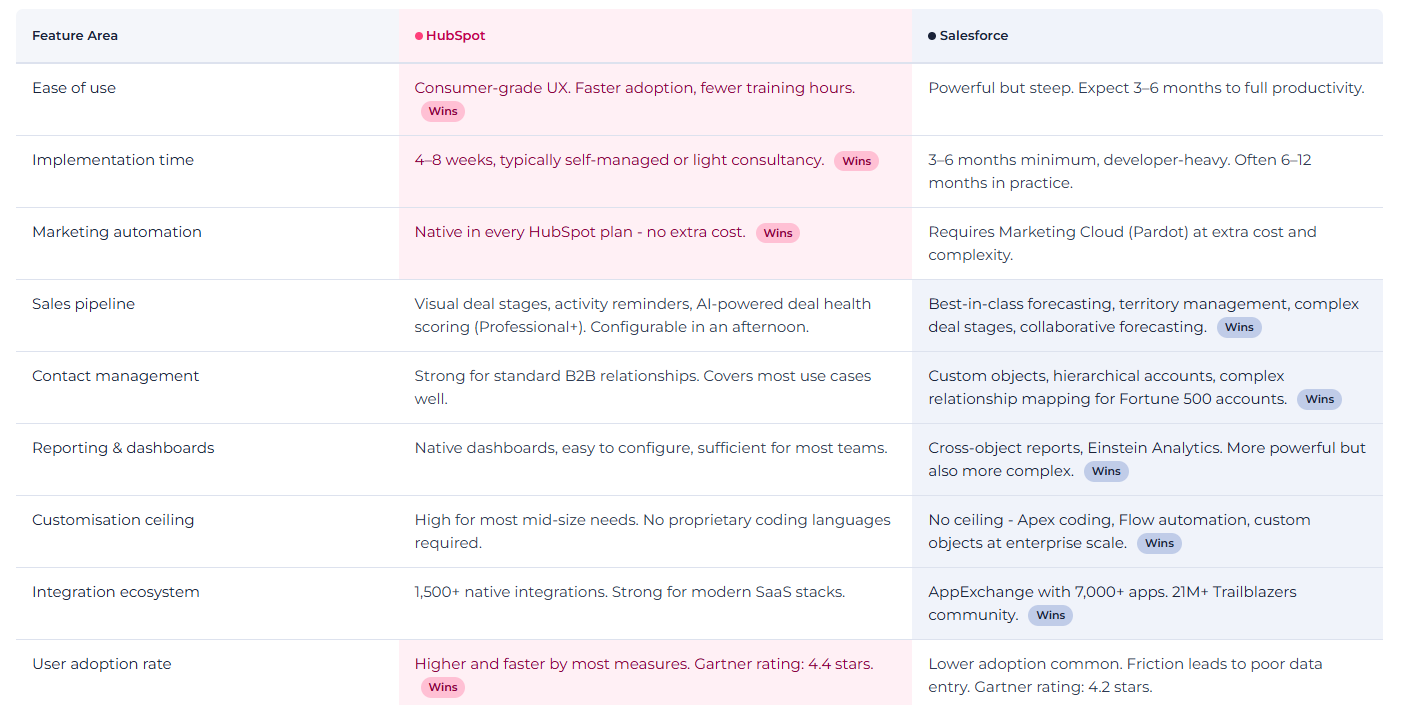
Feature-by-Feature Comparison
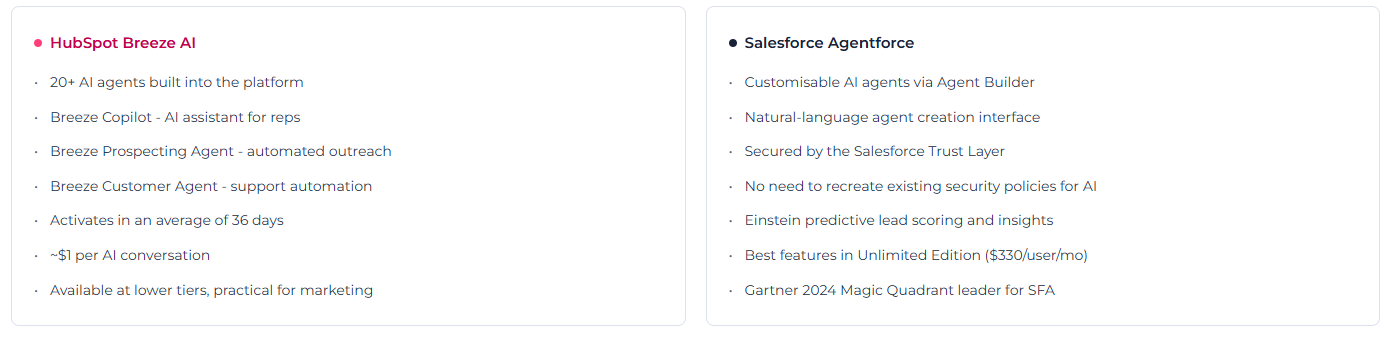
AI in 2026: Breeze vs Agentforce
Both platforms launched full AI agent ecosystems in the past year, and they take dramatically different approaches. This is perhaps the most interesting new dimension of the comparison.
User Adoption: Where Deals Are Won or Lost
The best CRM is the one your team actually uses. This is the criterion that gets the least attention in feature comparison guides and causes the most real-world pain.
HubSpot consistently delivers faster time-to-productivity for new hires, largely because of its consumer-grade UX. A G2 reviewer from a SaaS company described switching from Salesforce after two years: their 12-person team was fully onboarded in HubSpot within two weeks, with no external consultants needed.
Salesforce's learning curve is steeper by design - it's a platform built for customisation at enterprise scale, which means complexity is baked in. This often requires paid training sessions and creates friction for sales reps, leading to poor data entry. Poor data entry leads to bad attribution, which leads to bad decisions.
By the numbers: On Gartner Peer Insights in the B2B Marketing Automation Platforms market, HubSpot holds a 4.4-star rating from 2,181 reviews versus Salesforce's 4.2 stars from 702 reviews. HubSpot also scores higher on willingness to recommend.
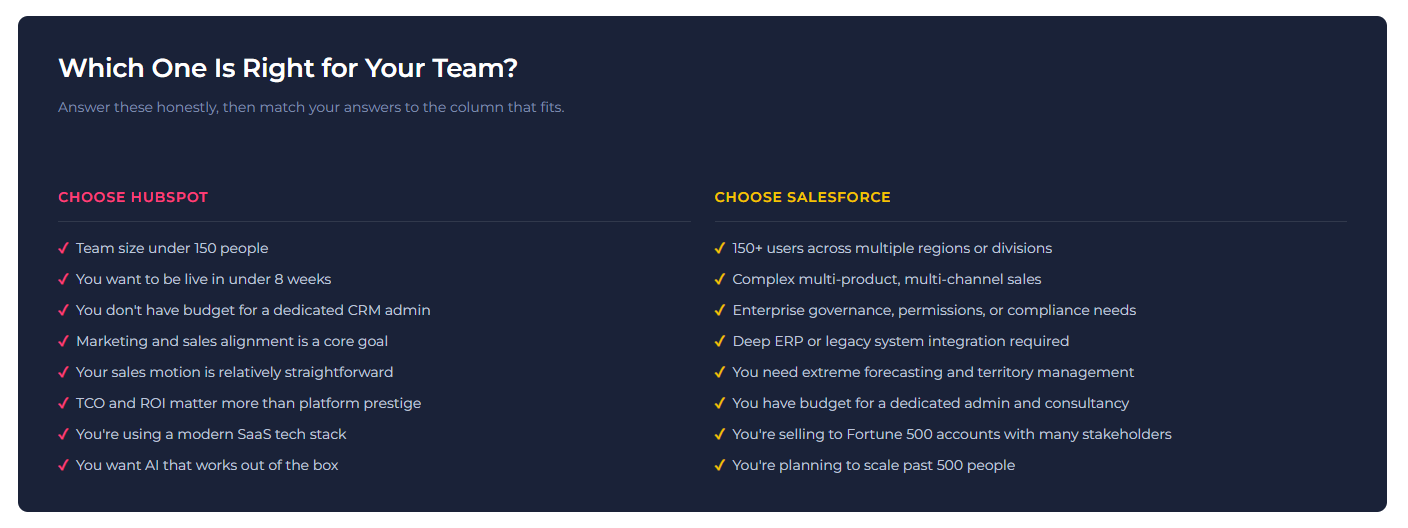
The split decision: If your answers are mixed between both columns, start with HubSpot. The consensus recommendation from RevOps practitioners is to start with HubSpot and revisit the decision at 100+ employees, rather than overpaying for Salesforce complexity you don't yet need.
Implementation Reality Check
Implementation is where most teams get burned - regardless of which platform they choose. The common mistakes are: skipping change management, under-investing in admin support, and trying to turn on every feature at once.
For HubSpot, a standard mid-size implementation takes 4–8 weeks and can often be led by an internal RevOps or Sales Operations manager. No proprietary coding languages (like Apex) are required to customise the platform. If you move carefully, you can be fully operational before most Salesforce projects have finished their discovery phase.
For Salesforce, a standard mid-size implementation typically takes 3–6 months and requires a specialised consultancy. Implementation fees are often 1:1 with your first-year license cost - a fact that shocks many buyers who compare only the software contract. Budget for €30,000 – €100,000+ in professional services, and build in time for ongoing admin support.
The fastest way to make the right decision is a controlled pilot. Stand up both environments with the same minimum viable data model, connect email and calendar, and have a small SDR pod run real outbound for a few weeks. You'll learn quickly which platform produces cleaner activity capture, faster follow-up, and fewer "where did this lead go?" problems.
Frequently Asked Questions
The warbble take
After looking at pricing, features, AI, implementation, and adoption, the honest conclusion for most mid-size B2B teams is clear: HubSpot offers a faster path to revenue impact at significantly lower total cost. The gap isn't a matter of brand preference - it's a TCO difference that commonly reaches 2x – 3x over three years.
Salesforce earns its premium when your sales motion genuinely demands it: extreme customisation, enterprise governance, complex multi-region territory management, or Fortune 500-level relationship complexity. If those are your problems, Salesforce's higher ceiling is worth paying for.
For everyone else - and that's most mid-size B2B teams - HubSpot gives you a platform your team will actually use, a marketing-sales stack that's natively integrated, and the budget headroom to invest in the things that actually grow revenue: better data, better sequences, and better people.
Whatever you choose, the CRM won't prospect for you. Invest in clean data, clear lead lifecycle stages, and the operational discipline to make the system work. The platform only matters because it either supports or fights the way your revenue team actually works.
.png?width=1584&height=396&name=warbble.digital%20Thrive%20Hubspot%20experts%20(4).png)